Insights
An $800 day rate looks pretty good next to a $150,000 salary. But before you start mentally spending the difference, there’s a bit of maths to do.
Multiply $800 by 260 weekdays and you get $208,000. Lovely. Except that assumes you work every weekday of the year, with no holidays, no sick days and your next contract starting immediately after the last one.
Even your calendar would have questions.
Candidates regularly ask us whether a contract offer stacks up against their perm salary. Hiring managers have their own version: is a contractor worth the extra spend, or should we hire someone permanently?
The answer starts with the numbers, but there’s more to it than whichever offer has the biggest dollar sign.
Your perm salary brings a few friends
When you compare a salary with a day rate, you need to include what comes with each.
For a full-time permanent employee, that generally means:
- Super: the current compulsory rate is 12%. Check whether the advertised salary is a base figure or already includes it.
- Annual leave: usually four weeks of paid leave each year.
- Personal leave: ten days of paid sick and carer’s leave each year.
- Public holidays: paid time off when the holiday falls on a day you would normally work.
- Regular pay: your salary generally continues when one project finishes and you’re waiting for the next piece of work.
Those super and leave entitlements make a real difference to the comparison. Australian Taxation Office
For this blog, we’re comparing perm employment with day rate contracting where you’re paid only for days worked. Fixed-term employment is different, and independent contractors don’t receive the same employee entitlements. Check how you’ll actually be engaged before comparing offers. Fair Work Ombudsman
Because “contract” on a job ad doesn’t tell you the whole story.
Let’s put some numbers against it
Take a $150,000 base salary plus super as an example.
To compare it with a super-inclusive day rate, we’ll allow for four weeks off, ten weekday public holidays and five sick days. These are budgeting assumptions, so adjust them to match your plans.
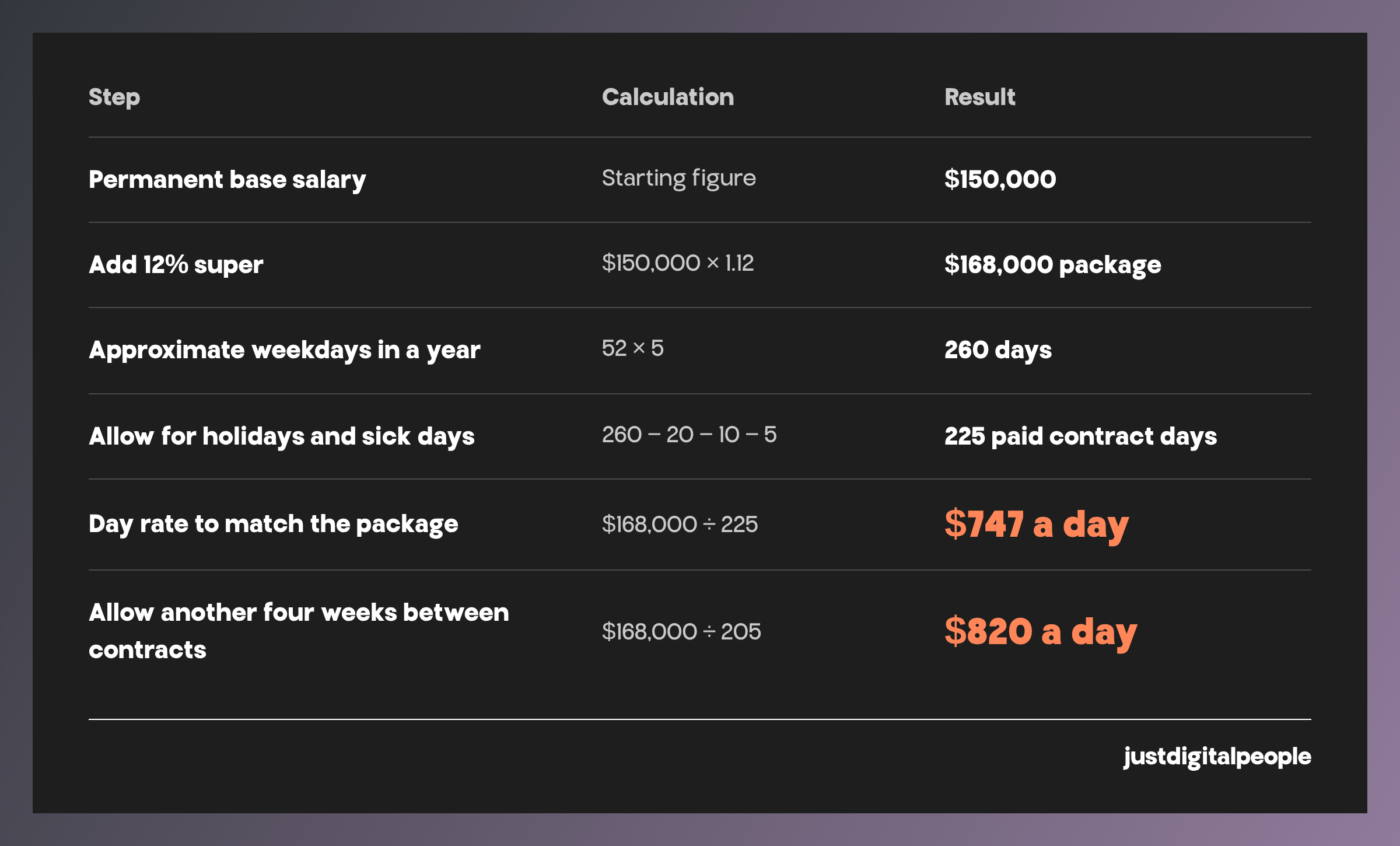
That puts an $800 day rate including super in a different light.
At 225 paid days, it produces a $180,000 annual package. At 205 paid days, it produces $164,000, slightly below the permanent package in our example.
Same rate, different year. And quite a different conversation.
These figures compare gross packages before tax and any additional contracting costs. They also assume comparable working hours, because an eight-hour day and a ten-hour day deserve separate conversations.
Three questions before you say yes
The headline rate gets your attention. These details tell you what it’s worth.
- Does it include super? An $800 rate plus super and an $800 rate including super are different offers. Get that confirmed before doing the maths.
- How many days will you realistically be paid for? Factor in holidays, shutdowns and time between contracts. An extension might happen, but “likely to extend” won’t pay the bills if it doesn’t.
- What costs sit with you? Depending on your arrangement, you may need to allow for insurance, accounting or other business expenses. Check what’s covered before treating the difference as spending money.
A handy starting formula is:
Permanent base salary × 1.12 ÷ expected paid contract days
Dividing your base salary by 200 gives a quick ballpark close to the 225-day example. It won’t cover every situation, particularly if you expect a longer gap between roles.
For candidates: will you actually enjoy contracting?
Once the numbers stack up, think about the working life attached to them.
A higher rate is appealing, but so is booking a holiday without calculating how much your out-of-office reply will cost.
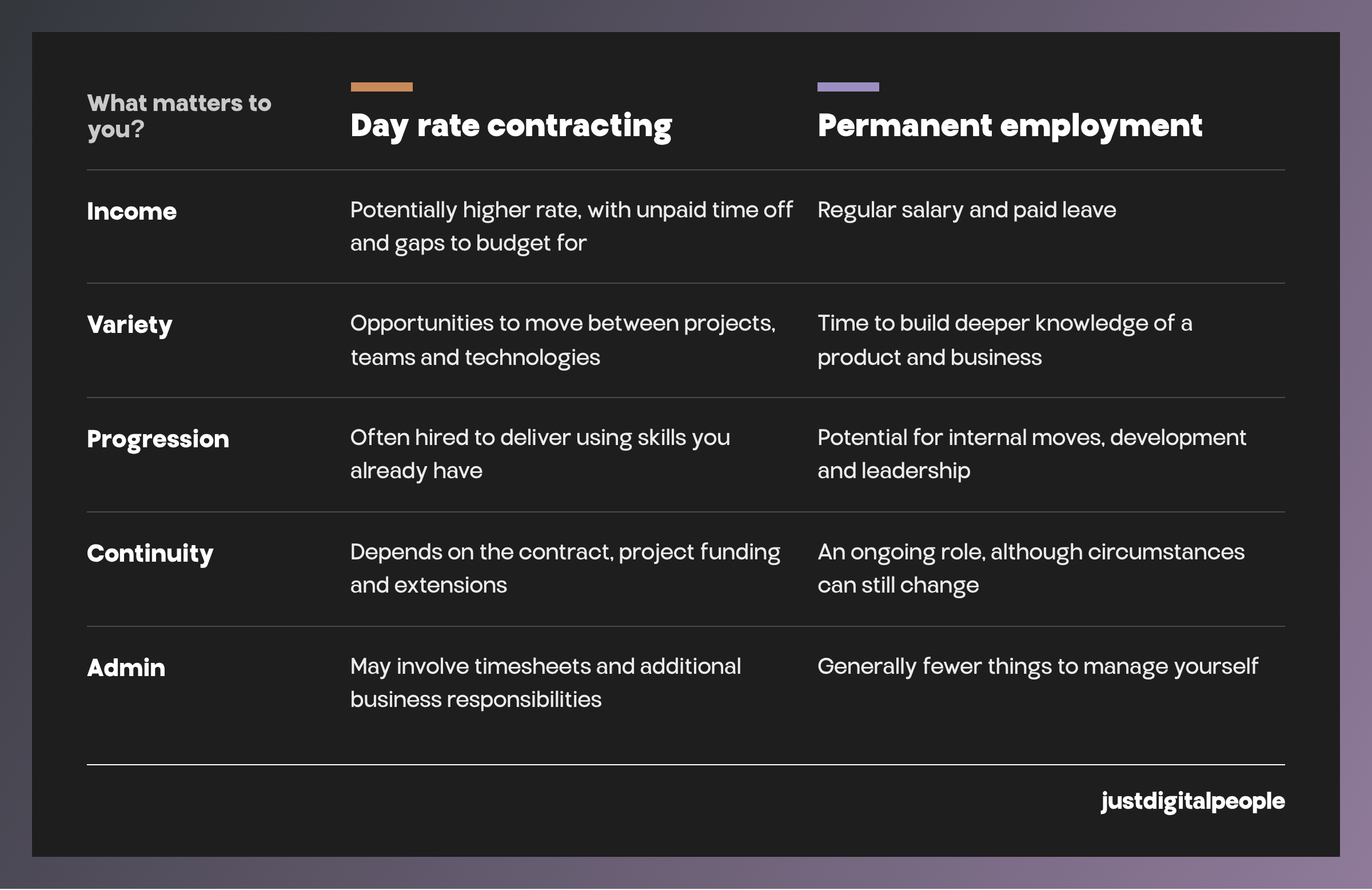
Contracting can suit people who enjoy getting stuck into a project, solving a specific problem and moving on to the next challenge. Having savings to cover a quieter patch helps too.
Perm can be a better fit if you want to see a product evolve, build a team or grow into responsibilities you haven’t taken on before.
Read the actual opportunity closely, though. A permanent role doesn’t automatically come with great development, and a contract doesn’t automatically mean exciting work.
You’re choosing a job as well as a pay structure.
Plenty of people move between the two throughout their careers. What suited you three years ago doesn’t have to suit you now.
For hiring managers: what are you hiring someone to do?
A contractor’s day rate can look expensive beside a permanent salary, particularly when you multiply it across a whole team.
But the useful question is whether the arrangement fits the work.
Contract can make sense when:
- You have a defined project, such as a migration, launch or platform rebuild.
- You need specialist skills for a particular stage of delivery.
- You need extra capacity for a busy period.
- You need someone who can contribute quickly, with a clear brief and the right experience.
Perm can make sense when:
- The work is ongoing and central to your business.
- You need someone to build context and take long-term ownership.
- Mentoring, team development and continuity are part of the role.
- You keep extending the same contract because the need hasn’t gone away.
That third extension is usually a good moment to revisit the plan. There may be a sound reason to keep contracting, but it’s worth checking whether the role has become an ongoing need.
For the budget comparison, include the full cost of each option, including any agency fees or employment costs. Paid leave is already covered by an annual salary, so account for reduced working days without adding the same cost twice.
And whichever route you choose, allow for onboarding. Even a brilliant contractor needs access to the systems before they can fix them.
So, is the day rate worth it?
Start with your current package, work out how many contract days you expect to be paid for, then compare what’s left after any additional costs.
If the contract only matches your permanent package, think carefully about what you’re getting in return for the uncertainty. It might be a brilliant project, a new skill or flexibility you’ve been looking for. Those things have value too.
If it pays comfortably more and suits how you want to work, it could be a very good move.
We like a good day rate. We like knowing what it actually means even more.
Whether you’re weighing up an offer or deciding how to build your team, get in touch with JDP. We’ll help you compare the numbers, the role and what makes sense for you, without turning it into a sales pitch.
The calculations are illustrative. Your engagement arrangement, tax position and costs will affect the comparison, so speak with an accountant for advice on your circumstances.
Wondering what your skills could be worth in 2026/27?
Our next JDP Salary & Market Guide is on its way, with salary benchmarks and market insights to help you weigh up your next move or plan your next hire.
Sign up to the JDP newsletter for early access and get into the numbers before everyone else does.